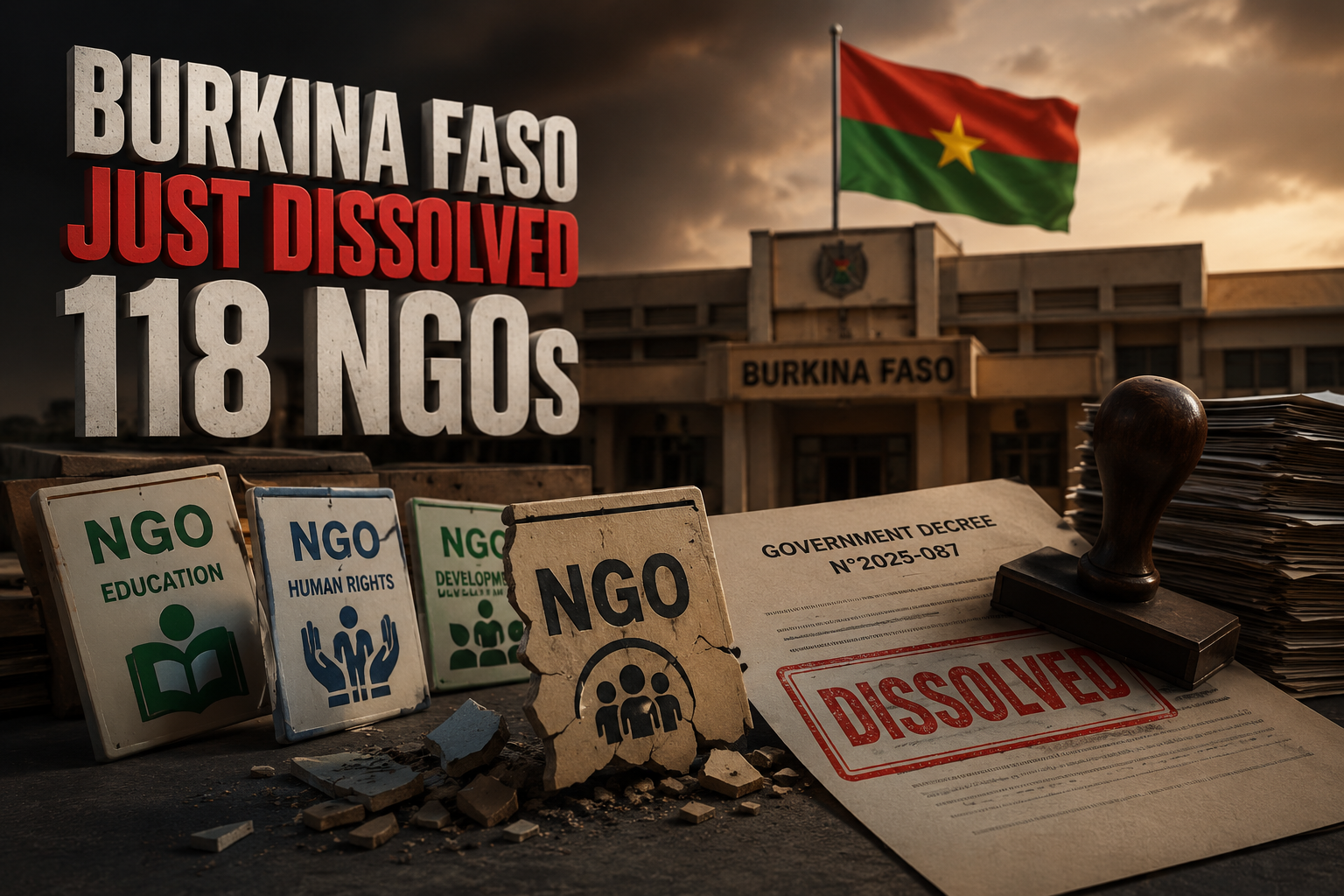
Burkina Faso just dissolved 118 NGOs. On 15 April 2026, the transitional government of Burkina Faso, led by Captain Ibrahim Traoré, enacted a sweeping decree that resulted in the immediate dissolution of 118 non-governmental organisations (NGOs) and civil society associations. The announcement, delivered by the Ministry of Territorial Administration and Mobility, marks a significant escalation in the junta’s efforts to centralise control and reassert national sovereignty. While the government officially cited non-compliance with Law No. 011-2025, a regulatory framework adopted in July 2025, the move has sent shockwaves through the international community and domestic human rights circles. This mass banning includes a broad cross-section of society, from prominent human rights defenders and health-focused groups to media outlets and religious organisations.
The Security Catalyst: Weapons and Espionage
The primary justification for such a drastic measure is rooted in the junta’s deep-seated suspicion of foreign influence and its alleged ties to the ongoing insurgency. A pivotal moment occurred in May 2025, when Burkinabè security forces intercepted 47 vehicles at the Togo border. Although these vehicles were prominently disguised as humanitarian aid, they were found to be transporting an estimated $100 million worth of weapons, including AK-47s, rocket launchers, and anti-aircraft missiles.
Following this event, the Traoré administration has increasingly characterised foreign-funded organisations as “imperialist labs” and political tools used to undermine the Burkinabè state. Authorities have alleged that certain NGOs have moved beyond their humanitarian mandates to participate in espionage or the direct funding of terrorist groups such as ISIS and JNIM. For instance, the government specifically accused the International NGO Safety Organisation (INSO) of involvement in funding terrorism in October 2025.
The Legal and Financial “Choke Point”
The dissolution is the enforcement of a legal architecture designed to monitor and restrict the activities of non-state actors. Law No. 011-2025 mandates strict declaration procedures, government oversight, and burdensome administrative requirements. Additionally, a controversial decree issued in November 2025 required all NGOs and associations to transfer their funds and manage their accounts exclusively through the Banque du Trésor (BDT).
The Global NPO Coalition on FATF has expressed serious concerns regarding the BDT mandate, noting that it creates a financial “choke point”. The BDT is not a commercial bank but a public financial institution integrated into the Treasury, governed by public law rather than private banking regulations. Critics point out that the BDT lacks a SWIFT code and a functional online payment platform, meaning transactions are often processed manually through paper-based systems that can take 5 to 7 working days. For humanitarian organisations collectively processing approximately 3.5 billion CFA (USD 6 million) per month, such delays are potentially life-threatening for populations in need.
Sovereignty and the “Upright People”
To understand the government’s perspective, one must view the dissolution of these 118 NGOs as part of a broader, Thomas Sankara-inspired revolution focused on self-reliance. Under Traoré, Burkina Faso has actively sought to break what it calls the “script” of managed dependency written in Paris and Washington. This drive for “total sovereignty” has manifested in several ways:
- Economic Independence: In March 2026, the government unveiled a $64 billion National Development Plan to be financed largely through domestic revenues and citizen shareholding.
- Nationalisation of Resources: The state nationalised five foreign-owned gold mines in June 2025, using the proceeds to repay over $2 billion in debt and reduce domestic debt by a quarter.
- Food Sovereignty: The administration claims that through targeted production campaigns and subsidies, Burkina Faso reached food self-sufficiency in 2025, transforming food from emergency relief into national infrastructure.
- Industrialisation: Projects like Faso Kosam, a state-owned dairy enterprise, aim to ensure the population consumes what it produces locally.
Proponents of the government argue that if an organisation—even a religious one like Radio Evangelia Development—refuses to comply with the laws of the land, it has no place operating within the country.
The Human Rights Crisis and Silencing of Scrutiny
In contrast, international observers and human rights advocates view the mass dissolution as a “flagrant attack” on the freedom of association guaranteed by the Burkinabè Constitution. Amnesty International and Human Rights Watch have argued that the measure is politically motivated, intended to silence those who document military abuses against civilians.
Groups specifically targeted include Action by Christians Against Torture (ACAT) and the Burkinabè Coalition for Women’s Rights (CBDF). Their dissolution occurs against a backdrop of reported atrocities committed by Burkinabè forces and allied militias (VDPs). For example, a December 2023 massacre in the town of Bouro resulted in the deaths of at least 211 civilians, many of whom were found with bullets in their heads and chests. Human Rights Watch reports that between January 2023 and August 2025, security forces were responsible for slaying over 1,200 civilians. By dissolving the organisations that monitor these events, the junta is accused of creating a climate of fear and avoiding accountability.
The Extension of Military Rule
The dissolution of the 118 NGOs follows the suspension of all political parties in January 2026 and the banning of several foreign media outlets, including TV5 Monde. UN Rights Chief Volker Türk has urged the junta to reverse these bans, stating that instead of jailing critics, the authorities should open space for civil society.
However, Captain Traoré has been clear that democracy is a secondary concern to national survival and security. The transitional period, originally set to end in July 2024, has been extended by five years, ensuring military control until at least 2029. As the government moves to reclaim 75% of the country’s territory from jihadist groups, it views any non-compliant entity as an obstacle to its mission.
A Fragile Future
Burkina Faso currently faces a complex reality where macroeconomic growth is projected at 5%, and poverty has declined in rural areas, yet 4.4 million people remain in desperate need of humanitarian assistance. The forced transition to the BDT banking system and the mass dissolution of NGOs may disrupt the very services required to sustain these populations.
For the “upright people”—the Burkinabè—the central question remains whether the pursuit of sovereignty justifies the dismantling of the institutions designed to protect their fundamental rights. As the junta characterises NGOs as agents of foreign powers, the country risks further isolation from international developmental partners and regional safety networks. The fate of these 118 organisations serves as a bellwether for the future of civil liberties and the rule of law in the Sahel.
About the Author