
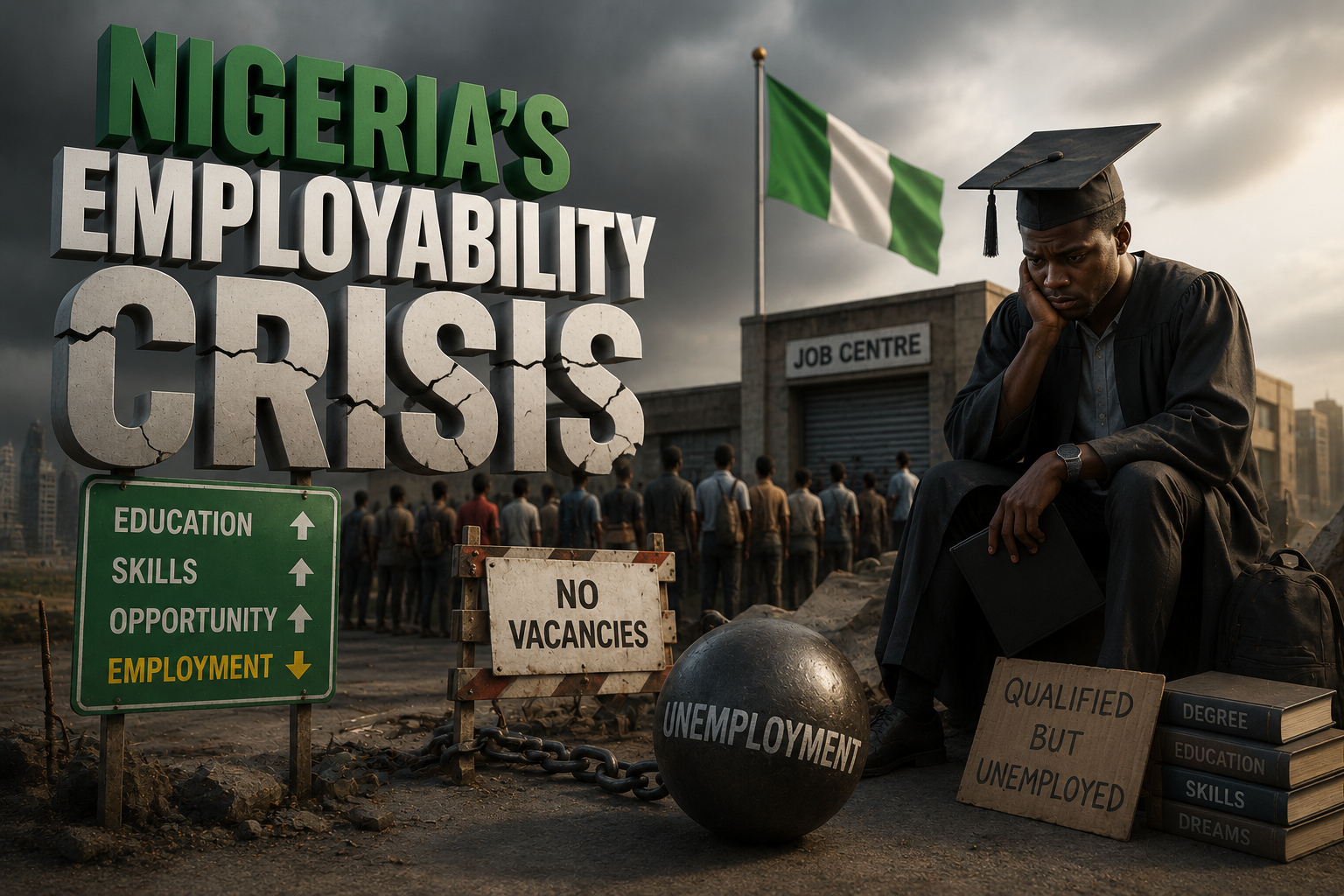


The narrative that Nigerian youth are “unemployable” has gained significant traction, recently highlighted by the Founder of Moniepoint, who stated he cannot fill 500 vacancies because of a lack of suitable talent. This sentiment is echoed across various sectors, such as a cold room business owner struggling to find staff despite offering a competitive monthly salary of N200,000 to N250,000. However, a closer examination reveals that this is not a unique character flaw of Nigerians, but rather a complex structural illusion, Nigeria’s Employability Crisis.
A Global Skills Mismatch
It is essential to recognize that the “employability crisis” is a global phenomenon, not a local one. As of 2025, the United States has over 8 million unfilled job vacancies due to a mismatch between education and employer needs, while Germany and Japan are facing their worst skilled labour shortages in history. Even China, with its massive population, struggles with millions of unemployed graduates while factories remain desperate for skilled technicians. This suggests that the issue is a structural development problem that economies face at various stages of growth, rather than a lack of individual intelligence or discipline.
The Paradox of Nigerian Resourcefulness
There is a profound contradiction in the claim that Nigerians are unemployable, particularly when looking at companies like Moniepoint. The very foundation of Moniepoint’s billion-dollar payment infrastructure is built on the resourcefulness of Nigerians: the street agents in Oshodi and Kano, market women using POS terminals, and small business owners who adopted digital payments. It is a paradox to build a successful business model on the back of local intelligence and then question the intelligence of that same population.
The Leadership and Training Gap
Historically, the most sophisticated companies have not merely “hired” competence; they have built it. When Japan faced a post-war skills crisis, Toyota developed its own internal training philosophy to turn raw, unskilled workers into world-class talent. If a technology company in a developing economy expects to find talent “fully formed” without investing in internal training infrastructure, it represents a leadership gap rather than a talent problem.
Redefining “Employable”
The current definition of “employable” in Nigeria is often narrowly modelled on Silicon Valley and Western corporate frameworks. This ignores the extraordinary economic skills young Nigerians demonstrate daily:
- Managing complex logistics entirely through WhatsApp without formal training.
- Operating thrift systems for hundreds of people with zero defaults and no software.
- Repairing engines and electronics with improvised tools that should not work.
These individuals possess high-level intelligence and problem-solving skills; they simply are not packaged in a CV format that fits a Western corporate template.
A Systemic Failure, Not a Personal One
The employability gap is ultimately a structural problem rather than a motivation problem. It is the result of a broken education system that produces graduates without practical skills and an economy that lacks enough industries to provide real-world work experience. When the output—in this case, the workforce—is consistently disappointing, the solution is not to blame the output, but to examine the process and the “soil” in which they were given to grow. Until there is an honest interrogation of the system rather than the individual, the crisis will only continue to escalate.