
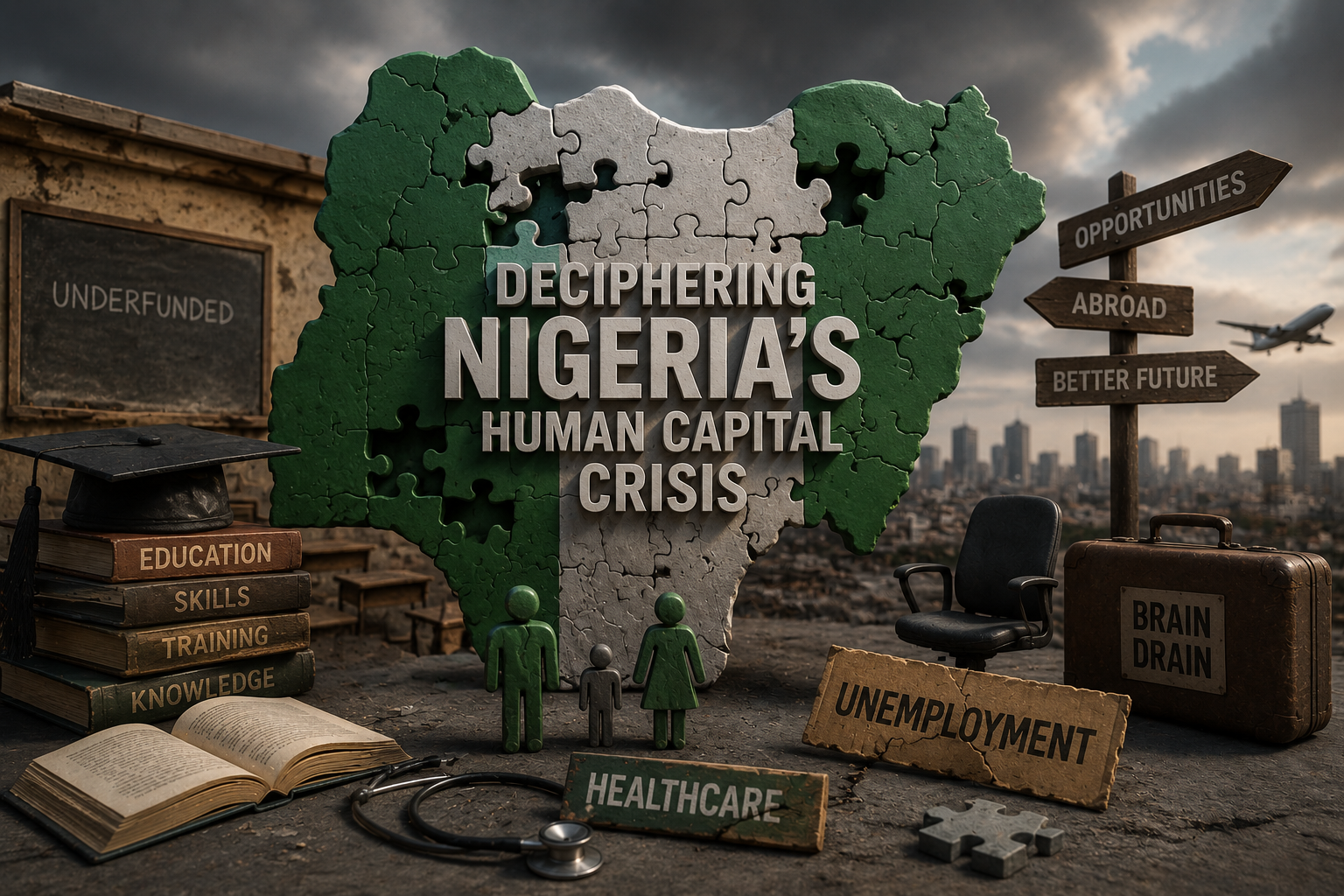


The prevailing narrative that Nigerian youth are simply “unemployable” is a dangerous oversimplification that masks a profound structural malfunction of the human capital ecosystem. While tech founders and business owners report hundreds of unfilled vacancies, a data-driven interrogation reveals that the crisis is not a character flaw of a generation, but the result of misaligned education, jobless economic growth, and a chronic leadership gap, which has led to Nigeria’s Human Capital Crisis.
The True Causes: A Triad of Structural Barriers
The crisis is fueled by three distinct but interlocking systemic failures:
1. The Education-Industry Schism:
There is a 60.6% skills mismatch in Nigeria, driven by a profound disconnect between academic training and labor market demands. The crisis is qualitative rather than quantitative; approximately 60% of university lecturers surveyed have not updated their curricula in over six years, a staggering delay in a global economy reshaped by AI and automation. Consequently, the system emphasizes rote memorisation over practical, technical, and soft skills like critical thinking and adaptability. This creates a “treadmill of unemployability” where graduates possess degrees but lack the “workforce readiness” required to thrive in professional environments.
2. The Paradox of “Jobless Growth”:
Nigeria’s economy has historically experienced expansion that fails to induce proportional formal employment. This is largely due to an over-reliance on the capital-intensive oil and gas sector, which accounts for 80% of budgetary income but provides negligible direct employment. While the services sector has absorbed some labor, it is bifurcated: most workers are pushed into low-productivity informal roles (93% of the workforce) rather than modern, high-value tech or financial roles. Furthermore, an infrastructure deficit—specifically unreliable electricity—costs the economy $29 billion annually, imposing operational hurdles that prevent SMEs from scaling and hiring.
3. The Leadership and Training Void:
A significant cause of the “unemployability” label is the “Experience Paradox,” where employers demand 3–5 years of experience for entry-level roles because they are unwilling to bear the costs of internal training. Unlike global standards set by companies like Toyota, which built world-class competence from raw talent, many Nigerian firms expect talent to arrive “fully formed”. Additionally, the definition of “employable” is often narrowly modelled on Silicon Valley frameworks, ignoring the extraordinary improvised economic skills young Nigerians demonstrate daily in logistics, repair, and informal finance.
The Impact: Brain Drain and Institutional Decay
This environment has triggered the “Japa Syndrome,” a mass exodus of highly skilled professionals. Between 2016 and 2018, Nigeria lost over 9,000 medical doctors to the West, leaving the country with a doctor-to-patient ratio of 1:10,000, far below the WHO recommendation of 1:1,000. This “net developmental detriment” erodes institutional memory, as the departure of senior professionals leaves junior staff without the mentorship necessary to maintain complex systems or meet regulatory standards.
The Solution: A Roadmap for Productivity
Solving the crisis requires moving beyond “palliative” interventions toward structural transformation.
- Curriculum Revolution: Education must be recalibrated through mandatory work-based learning and a shift toward STEM and vocational training. Curricula should be co-designed by industry leaders to ensure graduates meet real-world technical requirements.
- The “Talent Accelerator” Model: Nigeria must transition from isolated training schemes to a unified national skills system that tracks live market data and creates public-private partnerships for training delivery.
- Incentivizing the Private Sector: Instead of merely complaining about talent, the government should establish a National Productivity Fund to support firm-level innovation and worker upskilling. Furthermore, creating a “Health Development Bank” to provide low-interest loans could help retain medical professionals by improving local infrastructure.
- Formalizing the Informal: To break the “informality trap,” the government must reduce bureaucratic complexity and multiple taxation, making it easier for the 93% of informal workers to transition into the formal tax net and access growth capital.
Ultimately, the problem is not the “output”—the Nigerian youth—but the “soil” in which they are given to grow. Until there is a coordinated effort to fix the “Generator Economy” and bridge the education-industry schism, Nigeria’s demographic advantage will remain a liability rather than a powerhouse.
2 thoughts on “The Anatomy of a Systemic Failure: Deciphering Nigeria’s Human Capital Crisis”
Comments are closed.